What Makes a Founder Worth Betting On? Andre Charoo on Builder, Inventor, and Operator

"If everyone sees it, then what journey are we going on? What's the point?" says Andre Charoo, Founding Partner of Maple VC. Before writing a check, Charoo calls around ten people he trusts, from investors to operators, and asks what they think of the founder's vision. If fewer than nine push back, he loses interest. For him, that's a sign the idea may already be too obvious. A ten-year investment only makes sense if the founder sees something that most smart people haven't yet.
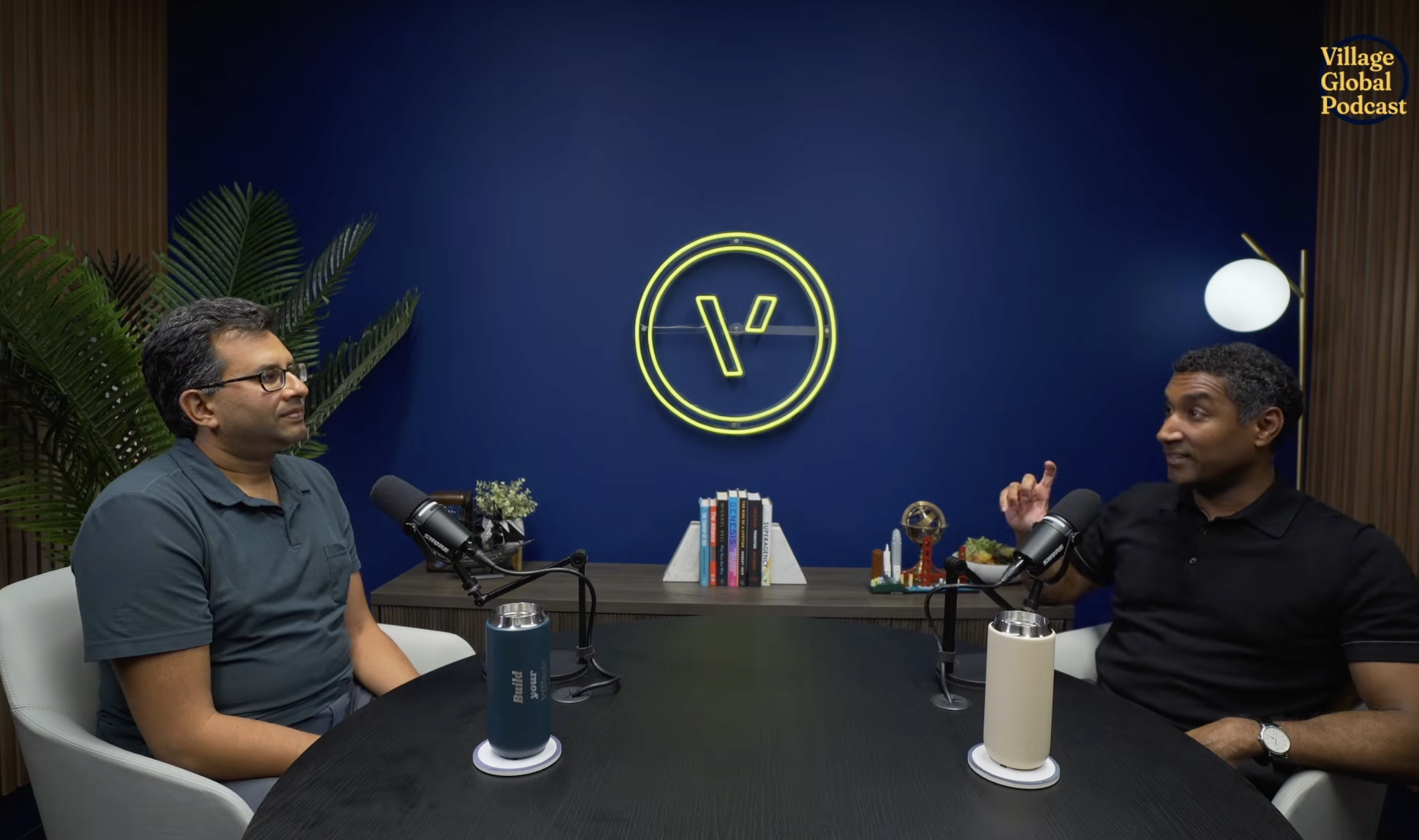
This episode of the Village Global Podcast, hosted by Amrit Rao, follows Charoo's path from Uber employee number 25 to founding Maple VC, and the framework he uses to evaluate founders when there isn't much else to go on: are they inventors, builders, or operators, and does that role fit what they're trying to build?
Key Insights
A linear answer can signal an inventor, not a builder
Charoo's test is simple. Ask a founder about their vision, then ask how they plan to get from zero to one. If the path is clear and easy to follow, that can be a sign that the founder is executing against an obvious plan.
"The more that it's not obvious, I know I'm talking to a builder," he says. "The more that I feel uncomfortable, the more that I'm like, I gotta go sit with that."
He points to Travis Kalanick describing Uber's vision as a logistics engine for an entire city, starting with a single black car. Some of Charoo's smartest colleagues laughed when he told them he was joining what looked like a limousine service. They saw the black car. Charoo saw what could come after it.
Charoo wants nine out of ten smart people to disagree before he'll write a check
Charoo's diligence process is unusually direct. Before investing, he calls around ten people he respects and asks what they think of the founder's thesis. If fewer than nine disagree, he loses interest.
"If everyone sees it, then what journey are we going on? What's the point?" he says.
For Charoo, the disagreement isn't just about being contrarian. It's a way to test whether the founder's idea can hold up when people who understand the market push back.
Bringing in an operator too early can change the company before it's ready
Charoo has a personal example of getting this wrong. As an early hire at Cinemagram, a video app that briefly outpaced Instagram before losing to Snapchat, he used his sales instincts to land distribution deals. Those deals ended up influencing the product before the founders' vision had fully taken shape.
"I think I literally went in there and changed the trajectory of the company," he says. The deals worked, but they also pushed the product in a direction the founders hadn't fully figured out yet. In the end, he thinks being good at his job became part of the problem.
He contrasts that with Uber's later approach to hiring operators, when the company was far enough along for experienced leadership to build on an established direction. For Charoo, the timing matters. An operator can be valuable once the vision and product have taken shape, but bringing one in too early can push a company in a direction before the founders have figured out what it should become.
A vision is not the same thing as a dream
Charoo credits his Maple partner John Edgar with a distinction he finds useful in venture: many founders pitch dreams when they need to be pitching a vision.
A vision lays out the market, the forces driving it, what's newly possible, and the obstacles between the company and where it wants to go. A dream can be compelling without giving an investor much to evaluate.
That difference changes the conversation. An investor can challenge parts of a vision, test the assumptions, and decide what they believe. A dream mostly asks them to believe the founder.
The people a founder attracts can say more than their credentials
Charoo looks at who a founder is able to bring around them. A founder who attracts PhDs, investment bankers, technical experts, and people from completely different backgrounds is showing something that a narrow group of similar supporters doesn't.
"We as humans are attracted to other people like ourselves," he says.
For Charoo, an unconventional background can actually make a founder more interesting. Someone with no nuclear engineering background building a nuclear reactor company has to convince people with much deeper expertise to join them. That ability to bring unlikely people along can be more revealing than a resume that perfectly matches the pitch.
Listen to the full episode on Apple Podcasts, Spotify, YouTube, or wherever you like to listen.
For insights from across the Village Global Network straight to your feed, follow us on X, LinkedIn, YouTube, Instagram, and TikTok.
About the Guest
Andre Charoo is founding managing partner of Maple VC and an executive fellow at Harvard Business School. He was employee number 25 at Uber and an early employee at Hired.com before founding Maple VC, a first-check venture firm now raising its fourth fund. Maple's early investments include Clay, Stadium Live, and Inference.ai.
About the Host
Amrit Rao is a General Partner at Village Global. Before Village Global, he spent over a decade in public markets investing at firms including Starboard Value and Tiger Management, and later co-founded and served as CEO of Made & Modern Furniture, an advanced-manufacturing company.