Michael Hochberg on AI, Software Moats, and the New Rules of Venture Capital

There's a piece of advice blunt enough that most founders never hear it stated this directly: Max Kilberg, Investment Partner at Village Global, tells the founders he backs that VCs are stupid, scared, and reductive. He doesn't mean it as an insult. He means it as the operating manual for how to actually get funded.
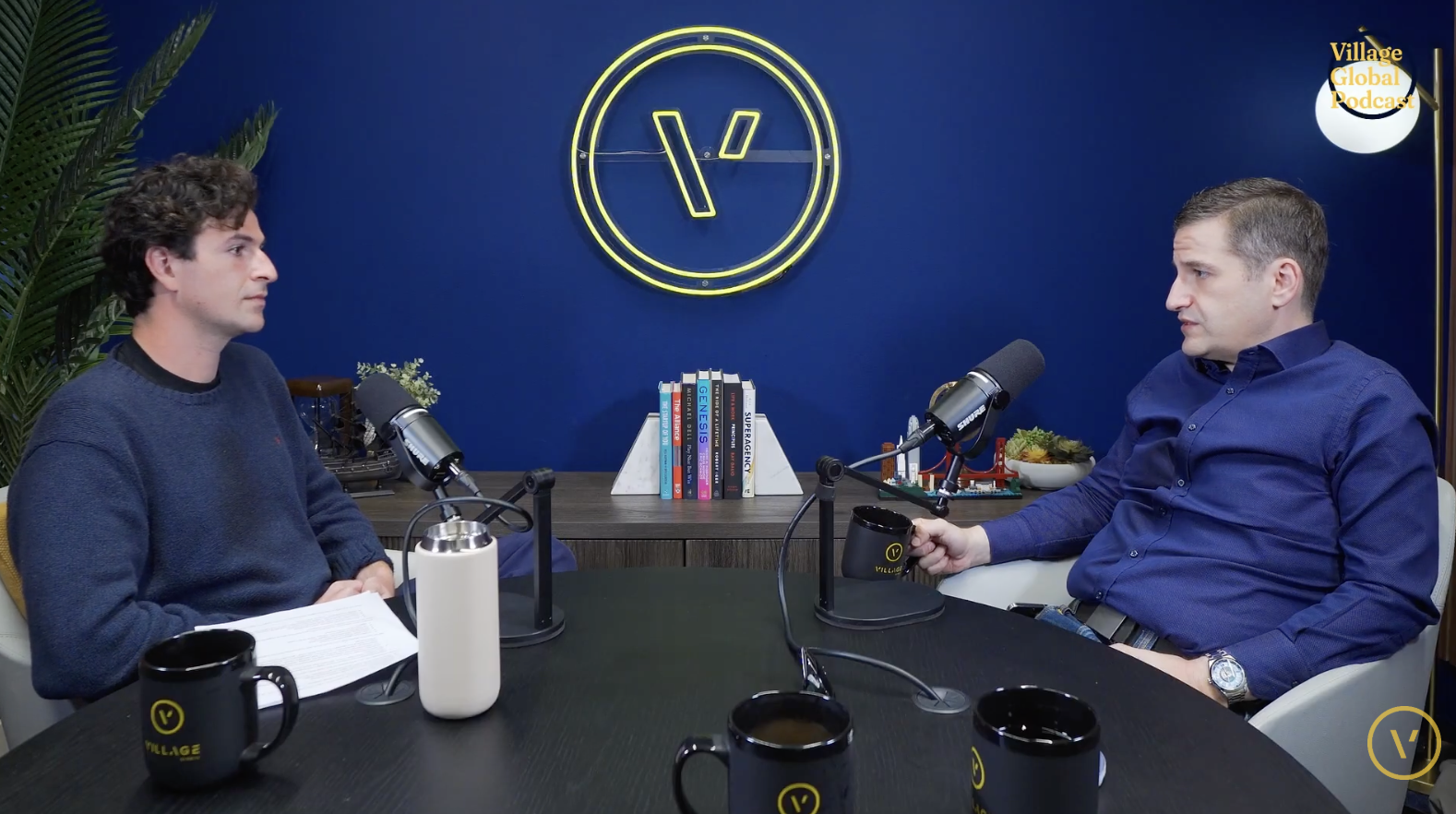
This episode of the Village Global Podcast, hosted by Kilberg, follows a conversation with Michael Hochberg, founder and president of Periplous LLC. They discuss what’s changing in venture capital, how companies decide what to build in-house, where AI liability could land, and why insurance companies may help shape the rules before regulators do.
Key Insights
VCs are constrained, so founders need to understand how they think
Max Kilberg has a blunt way of describing the problem. "VCs are stupid, VCs are scared, and VCs are reductive." He doesn't mean that investors are unintelligent. Most investors simply know less about the specific company they're evaluating than the founder does. They also have limited time and only a few opportunities they can seriously pursue each year.
That makes clarity especially important. Investors have to take what they've learned from a founder and explain it to the rest of their partnership. Kilberg recommends thinking about the one or two sentences you want an investor to remember after the meeting and repeat to their investment committee.
For founders, the goal isn't to make the idea less ambitious. It's to make sure the ambition can actually be understood.
A friendly VC meeting doesn't mean you're getting a term sheet
Hochberg brings up something many first-time founders learn the hard way. A meeting can go well, the investor can be enthusiastic, and everyone can leave feeling good about the conversation. Then nothing happens.
"The way that VCs say yes is they issue a term sheet," he says. "Anything short of that is a no, or a maybe, but not now."
Kilberg sees the fundraising process as a way to create momentum rather than waiting for a single investor to make a decision. He advises founders to talk to several funds at the same time, including some they may be less interested in, so that conviction from one investor can help create it with another.
When people see a startup announce a huge round, the process often started much smaller. Kilberg says a company might initially go out looking for $40 to $50 million, only to have two or three investors become highly convinced and start competing for the deal.
AI is changing what a software moat looks like
Kilberg is unusually skeptical about traditional software moats. "I'm a no moats exist believer, actually."
His argument is that AI makes it possible to build and launch products so quickly that having a particular feature or piece of software isn't necessarily much of a defense anymore. In his view, speed, talent, and the ability to keep moving may matter more.
Hochberg isn't convinced that this means software companies disappear.
Businesses have always been able to build their own software. They could build their own CRM instead of buying one, for example. But building something internally comes with maintenance, security, and accountability. Someone still has to own the decision and deal with the consequences if the system fails.
"Even if the costs to implement something comes to zero... some human has to take responsibility for making the decision to do it in-house as opposed to just paying for something that someone is selling you," Hochberg says.
That distinction becomes even more interesting as AI gets better. Some software may become almost interchangeable once it reaches a good-enough level. Other products could keep attracting customers because there is no clear ceiling on how much better the output can become. In those markets, customers may continue paying for the system that produces the best result.
The next AI bottleneck may be expertise, not models
The conversation moves from software moats to what companies actually need to make AI useful inside an organization.
Kilberg points out that enterprise AI isn't simply a matter of putting a foundation model in front of proprietary information. Companies need the right data, evaluations, workflows, and systems around the model. Much of the knowledge needed to do professional work well also isn't sitting neatly in a database.
A great lawyer, investment banker, or investor has years of judgment that isn't necessarily captured in a machine-readable document.
That creates another opportunity for companies building on top of the foundation models. The valuable layer may be the system that takes human expertise and turns it into something an AI system can actually use.
Insurance may shape AI liability before regulation catches up
Hochberg is particularly interested in what happens when AI moves from software into the physical world.
If an autonomous robot damages property or hurts someone, who is responsible? The person who deployed it? The company that built the hardware? The company that developed the model? What happens if the system was hacked?
There isn't a clean answer yet.
Hochberg thinks insurance companies could become an important part of figuring it out. If a company wants to deploy autonomous systems, it will eventually need someone willing to insure the risk. That insurer will have its own requirements around how the system is built, monitored, and secured.
"If you want to know what the future looks like, you pay attention to what the insurance companies are requiring people to do," he says.
Kilberg says something similar is already happening with agentic AI in the digital world. Insurance carriers are trying to work out how to cover AI systems that handle customer and financial data, but the risks are difficult to underwrite.
The AI boom isn't quite like the dot-com bubble
Hochberg has some personal history with technology bubbles. As a Caltech undergraduate, he made fun of friends who were starting e-commerce companies. His favorite example was selling cat food over the internet.
He was wrong.
The problem wasn't that the idea was bad. The infrastructure simply wasn't ready yet. Once it was, buying groceries and other everyday products online became completely normal.
That's part of what makes the current AI cycle different for him. The economic impact isn't necessarily something that needs to arrive ten years from now. It's already showing up.
"We're seeing things that five years ago I would have said violated the laws of physics," Hochberg says. He points to startups growing revenue at rates that would have seemed impossible just a few years ago, with real customers and real external revenue.
At the same time, most companies haven't figured out how to use AI anywhere near its full potential. Hochberg sees that gap as one of the biggest opportunities still ahead.
The application layer may be more interesting than investors think
While much of venture capital is currently focused on AI infrastructure, Hochberg is more optimistic about the application layer.
His argument is that AI could make software dramatically more capable, which could increase how much software people actually use. He also expects embodied AI and robotics to move faster than many people anticipate, with training data becoming a bigger constraint than hardware.
The broader point is that the technology is still moving quickly enough that it's difficult to know where the eventual boundaries will be.
For Hochberg, that's part of what makes the current moment interesting. We're still figuring out what these systems can do, often by trying things rather than following a settled theory of how they work.
Listen to the full episode on Apple Podcasts, Spotify, YouTube, or wherever you like to listen.
For insights from across the Village Global Network straight to your feed, follow us on X, LinkedIn, YouTube, Instagram, and TikTok.
About the Guest
Michael Hochberg is the Founder and President of Periplous LLC, an advisory firm focused on strategy, technology, and organization design. He holds a Ph.D. in applied physics from Caltech and has founded and sold four silicon photonics and semiconductor companies, including Luxtera, acquired by Cisco, and Elenion, acquired by Nokia, where he later served as CTO of Optical Subsystems. He is a network investor with Village Global and a visiting scholar at the Centre for Geopolitics at Cambridge University.
About the Host
Max Kilberg is an Investment Partner at Village Global, where he invests at the pre-seed and seed stages across industries and geographies, with a particular interest in frontier AI, including agentic and embodied AI. He previously worked at AngelList Venture and co-founded a startup in the hiring marketplace space. He studied economics and management science and engineering at Stanford University.