Tanay Kothari | From Wearable Hardware to AI Voice: The Story Behind Wispr Flow

Wispr Flow started as a wearable device built by a team of 40, mostly PhDs in neuroscience, electrical engineering, and mechanical engineering. Tanay Kothari, founder and CEO of Wispr, eventually cut the hardware after noticing something in the data: people kept using the software without it.
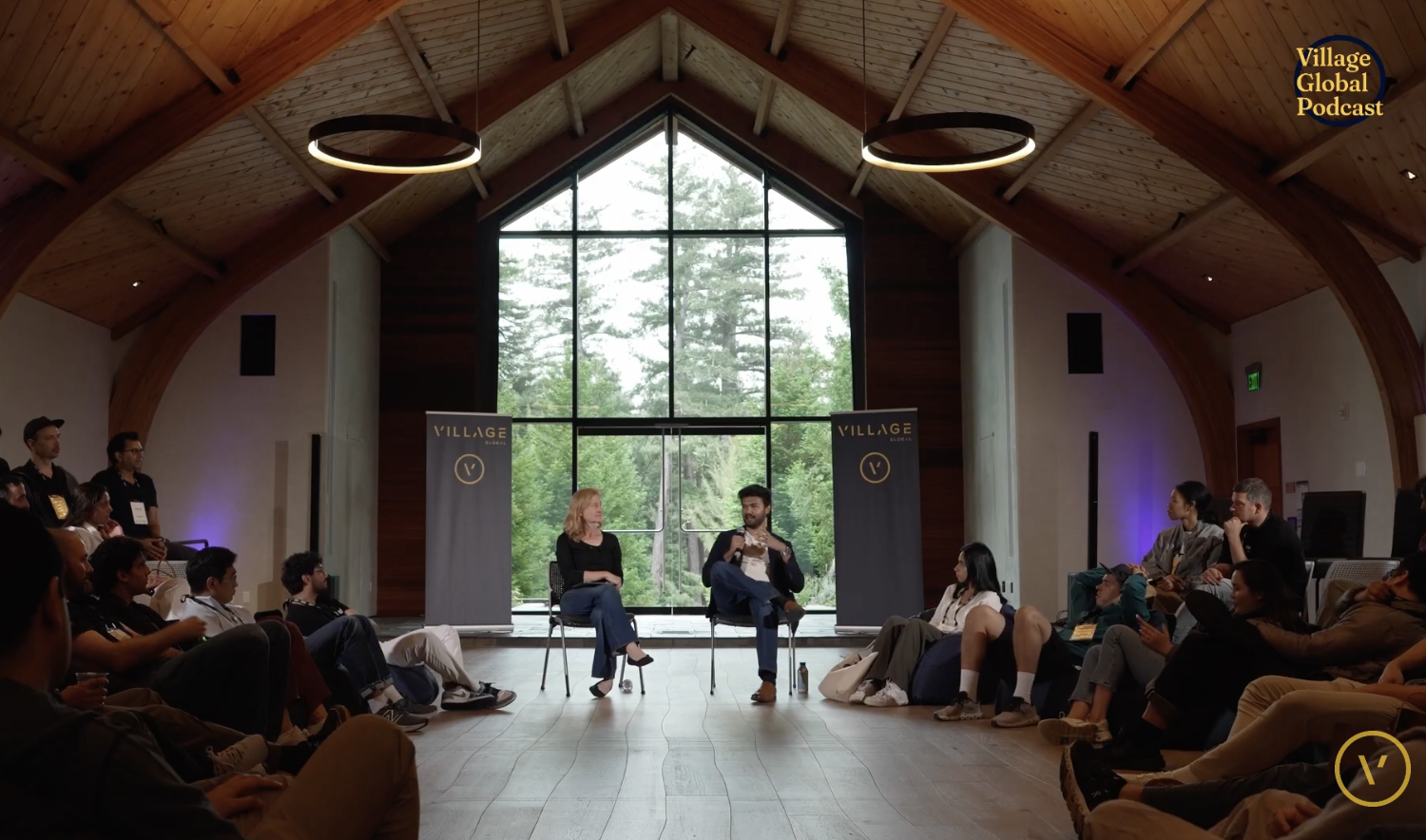
Earlier this month, Village Global hosted a Learning Circle led by Anne Dwane, Village Global co-founder and General Partner. She was joined by Kothari’s younger brother, Jaisal, who is also a Village Global portfolio founder.
Tanay shared the story behind Wispr, from secretly coding through the night at age 12 to building an early voice assistant called ARIA, years before Siri existed. The idea came from watching Iron Man and wondering whether Jarvis was something he could actually build.
Key Insights
The best product decisions come from humility, not conviction
Wispr began in 2021 with a bet that the “voice layer” for interacting naturally with AI didn’t exist yet, and that hardware would be necessary to deliver it.
The team spent three years building a wearable earpiece designed to turn thought-like, rambling speech into text. Kothari describes it as the world’s first silent speech device.
When they connected the system to ChatGPT, Siri, and Alexa during testing, all three performed poorly. But the more important signal came from users. When given a choice between the software and the hardware, people kept using the software and simply skipped the earpiece.
Kothari says this was a lesson in founder humility. Founder delusion, or the willingness to keep going when everyone tells you no, can be useful. But it only works when it is balanced with a willingness to look honestly at what users are doing.
The vision for Wispr didn’t change. What changed was the team’s belief about the best way to get there.
Zero edit rate, not word error rate
Word error rate is the standard benchmark for measuring transcription accuracy. Kothari wanted a metric that reflected what users actually experience.
His answer is zero edit rate: if a user dictates a three-paragraph email and has to fix even one mistake, the output has failed.
That distinction matters. A transcript can have a low word error rate and still contain enough small mistakes that a user doesn’t trust it. From Kothari’s perspective, that was one of Siri’s biggest problems. It could be technically accurate, but users still couldn’t rely on it without checking the output.
For a product built around voice, “almost right” isn’t good enough.
AI moats have compressed from five years of durability to about three months
A few years ago, Kothari says, having the best voice model could have given a company roughly five years of competitive advantage. Today, that advantage might last only three months.
That changes how Wispr thinks about defensibility. Instead of relying on one breakthrough, the company is building several advantages at once: the underlying model, product improvements driven by direct user feedback, enterprise workflows that become harder to replace over time, and increasing switching costs.
The company recently raised a quarter-billion-dollar round to build out a dedicated voice research team. That team is led by the former founding researcher for Alexa, who later ran voice and multimodal work at Meta. Wispr expects its ML team to grow from five people to 40 by the end of the year.
The idea is straightforward: if one advantage can disappear quickly, build a business with several of them.
Rejecting small, on-device models was a deliberate bet on who gets to use the product
Kothari has a view that runs against some of the conventional thinking in AI: Wispr needs cloud-based models, even though smaller on-device models are often seen as the more technically elegant solution.
His argument is that edge models still fall short of the accuracy Wispr needs. More importantly, building primarily for on-device processing can limit the number of people who can use the product.
“I don’t know how in Silicon Valley it’s very easy to say, oh, let’s build an edge model, let’s run everything offline, but then you just delete 99% of the world as your customer,” he says.
He points to his own family as an example. His uncle uses Wispr on an old Dell Windows laptop without a GPU. His grandfather uses it on an aging Samsung phone.
For Kothari, cloud infrastructure isn’t just an engineering decision. It allows Wispr to work for people who aren’t using the newest hardware.
Doubling headcount doesn’t double output, so Wispr rebuilt how teams communicate
“When you double your team size, the output does not double,” Kothari says.
He saw this firsthand as Wispr grew from 10 people to 25. Three-person Slack conversations became hundred-person channels. Everyone started weighing in on everything. Decisions that once involved two people began pulling in a growing number of stakeholders.
So Wispr changed how teams communicate.
Projects are assigned to the smallest team possible, often just two or three people. Slack channels are designed around the people actually working together rather than serving as open company-wide forums.
That does create a tradeoff: people outside the team have less visibility into what’s happening.
Wispr addresses that with automated updates. Each project channel has a bot that surfaces major decisions to the broader company, rather than depending on someone to remember to post an update.
Kothari says the result is a company that still feels like “10 startups operating inside one.”
Five hundred onboarding calls, watching expressions instead of screens
Kothari personally ran the company’s first 500 onboarding calls, and he still spends time watching people use the product.
He pays close attention to their expressions: when they look confused, when something excites them, and when a step starts to feel tedious. Those reactions often tell him more than what someone clicks.
The experience also varies dramatically between users. Onboarding someone technical can look very different from onboarding his father, who is much less comfortable with software, even though both are going through the same product.
Kothari continues to do informal versions of these sessions today. He’ll show Wispr to someone in an airport line or a coffee shop and watch how they respond in real time. Then he brings those observations back to the team.
For him, onboarding never really ends. As the product changes, there is always something new for the next user to figure out.
Listen to the full episode on Apple Podcasts, Spotify, YouTube, or wherever you like to listen.
For insights from across the Village Global Network straight to your feed, follow us on X, LinkedIn, YouTube, Instagram, and TikTok.
About the Guest
Tanay Kothari is founder and CEO of Wispr Flow, a voice dictation and AI assistant product. He started the company in 2021 with co-founder Sahaj, initially building a wearable hardware device before shifting toward the software that became Wispr Flow. The company recently raised a quarter-billion-dollar round and has grown its team roughly sevenfold alongside 40% month-over-month revenue growth.
About the Host
Anne Dwane is co-founder and General Partner at Village Global, a pre-seed venture capital firm chaired by Reid Hoffman that writes first checks at the pre-seed and seed stage. The firm backs founders before consensus forms across sectors including consumer, B2B, and AI.
Before Village Global, Anne co-founded Zinch, which was acquired by Chegg, and led Chegg’s enterprise business through its IPO. She previously served as CEO of Military.com, which was acquired by Monster Worldwide. She invests in pre-seed and seed-stage founders.